| Stack | Role | Year | Status |
|---|---|---|---|
| React, Node.js, Express, MongoDB, WebSockets, Three.js, React Three Fiber, JWT, Recharts, Framer Motion | Full-Stack Software Engineer | 2026 | Completed |
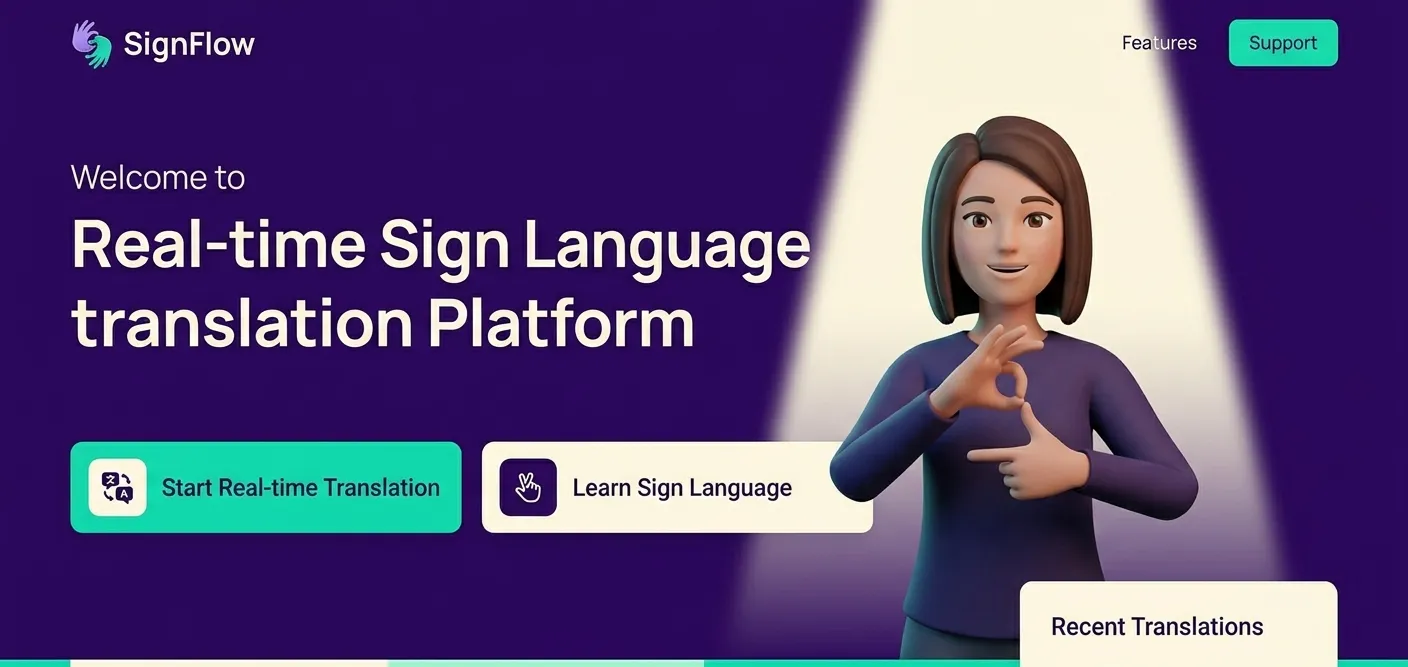
SignFlow - Real-Time Assistive Tech Simulation for Sign Language
Building a high-fidelity assistive technology simulation for real-time sign language translation
SignFlow - Real-Time Assistive Tech Simulation for Sign Language — Building a high-fidelity assistive technology simulation for real-time sign language translation is a technical case study on ancel.co.ke documenting architecture, trade-offs and outcomes. To move from robotic loops to a responsive, natural-feeling interpreter, I built SignFlow so translation streams in real time and the 3D avatar varies per phrase, with failures in rendering or network isolated from the core experience. Ancel Ajanga wrote this cas…
SignFlow is a high-fidelity assistive technology platform architected for real-time sign language translation, exploring the architectural requirements for scaling accessibility platforms. The system features WebSocket-powered streaming, 3D avatar simulation with natural variation and accessibility-first design with WCAG compliance, demonstrating production-grade architecture for specialized user bases.
The Problem
Current text-to-sign demonstrations suffer from robotic user experience with repetition, static nature, latency issues and UX gaps. Identical animations play for every word without variation, there's a lack of timing, facial expression, or prosody, poor real-time feedback loops and negligible consideration for accessibility. For assistive technology to be trusted by the Deaf and Hard-of-Hearing community, naturalness and responsiveness are as critical as linguistic correctness.
To move from robotic loops to a responsive, natural-feeling interpreter, I built SignFlow so translation streams in real time and the 3D avatar varies per phrase, with failures in rendering or network isolated from the core experience.
The Solution
I architected SignFlow as a sophisticated assistive technology platform with dynamic logic for per-word and phrase-based animation sequences, live streaming via WebSocket-powered translation for near-zero latency, responsive interface with high-fidelity 3D avatar that reacts to user input and accessibility-first design with UI built specifically for inclusive user experiences. By applying subtle variations to repeated inputs, SignFlow creates the illusion of a living interpreter rather than a looped animation, demonstrating production-grade architecture for specialized user bases.
Key Technical Terms
- Animation pools (seed-based variation):SignFlow stores multiple animation variants per word or phrase and picks one by seed so repeated words do not look identical; that supports the project goal of natural, human-like signing instead of a single loop.
- WebSocket streaming:Text is sent over a WebSocket and sign sequences stream back so latency stays low; for this assistive product that keeps the experience responsive and real-time without polling.
- 3D rendering isolation:Three.js/React Three Fiber runs in a layer separate from translation and API so a render glitch or heavy frame does not block the translation pipeline or crash the app.
The Impact
Fully implemented assistive technology prototype demonstrating real-time system design using WebSockets, scalable cloud architecture with MongoDB Atlas, intentional UX for specialized user bases and product-level thinking bridging coding projects and viable market solutions. The platform features high-fidelity 3D avatar simulation, natural variation in animations, comprehensive analytics dashboard and full WCAG accessibility compliance, showcasing enterprise-grade architecture for accessibility platforms.
Near-zero
Multiple
WCAG Compliant
MongoDB Atlas
Outcomes
- Fully functional assistive technology prototype with production-grade architecture
- Real-time translation system with WebSocket-powered streaming
- High-fidelity 3D avatar with natural variation and micro-expressions
- Comprehensive analytics dashboard with interactive charts and user insights
- Full accessibility compliance with WCAG standards
- Scalable cloud architecture with MongoDB Atlas
Architecture Deep-Dive
SignFlow follows a real-time streaming architecture: React frontend with Three.js (React Three Fiber) for 3D avatar rendering, Node.js/Express backend for translation processing, MongoDB Atlas for cloud-hosted data with indexed collections and WebSocket connections for near-zero latency streaming. Animation pools store multiple variations per word/phrase, with seed-based selection for natural variation. The architecture separates 3D rendering from translation logic, ensuring smooth performance. Analytics are computed on-demand using MongoDB aggregation pipelines.
Key Engineering Decisions
I chose WebSocket streaming over REST polling because near-zero latency was essential for sign-to-text feel, trading some complexity for real-time responsiveness. I selected Three.js over 2D animations because the immersive 3D avatar better served accessibility and user trust. I implemented animation pools over single animations so signing had natural variation and felt less robotic. I used MongoDB Atlas over self-hosted for cloud scalability and ops simplicity. I deferred voice input and video recording to ship the core translation experience first.
Failure Modes & Resilience
WebSocket disconnect: client reconnects and can resend input so the user is not stuck. 3D render or GPU failure: error boundaries contain the avatar component so the rest of the UI (text, controls) still works and we can show a fallback or retry. Translation service or DB slow: we show loading and timeouts so the user knows the system is working; we do not block the main thread. Missing animation for a word: we fall back to spelling or a default so the experience degrades gracefully instead of breaking.
Outcome & Future Potential
Fully implemented assistive technology prototype demonstrating real-time system design using WebSockets, scalable cloud architecture with MongoDB Atlas, intentional UX for specialized user bases and product-level thinking bridging coding projects and viable market solutions. The platform features high-fidelity 3D avatar simulation, natural variation in animations, comprehensive analytics dashboard and full WCAG accessibility compliance, showcasing enterprise-grade architecture for accessibility platforms.
Roadmap & Expansion
Vision includes scaling to 10,000+ concurrent users through WebSocket load balancing, Redis for session management and CDN integration for 3D assets. Planned containerization with Docker for consistent deployments. Advanced features include AI-powered sign recognition, multiple avatar personalization, sign language learning modules and community sharing capabilities. Enterprise features include API access for third-party integrations, white-label customization and comprehensive analytics dashboards.
Near-zero
WebSocket-powered streaming
Multiple
Per-word animation pools with natural variation
WCAG Compliant
Full ARIA support and keyboard navigation
MongoDB Atlas
Cloud-hosted with indexed collections
Project Gallery