| Stack | Role | Year | Status |
|---|---|---|---|
| React 19, Tailwind CSS, RainbowKit, Wagmi, ethers.js, Node.js, Express.js, MongoDB, Mongoose, Solidity, Hardhat, IPFS | Full-Stack Software Engineer | 2026 | Live |
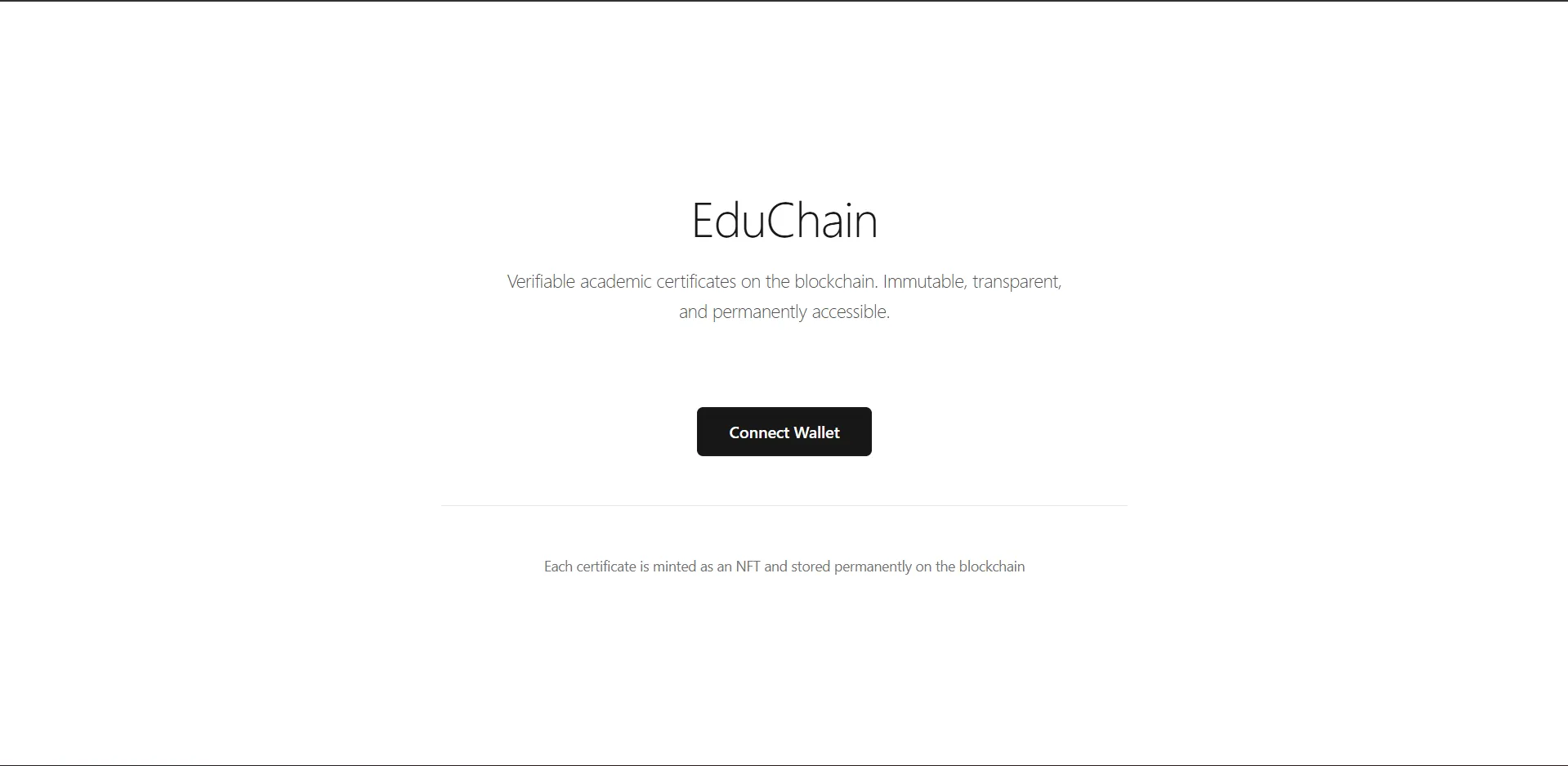
EduChain - Blockchain Certificate Management
Full-stack Web3 application for issuing verifiable academic certificates as NFTs
EduChain - Blockchain Certificate Management — Full-stack Web3 application for issuing verifiable academic certificates as NFTs is a technical case study on ancel.co.ke documenting architecture, trade-offs and outcomes. To make credentials tamper-proof and verifiable without a central authority, I designed a hybrid system that keeps issuance fast and cheap while putting permanent proof on-chain. Ancel Ajanga wrote this case study from hands-on delivery experience in Kenya.
EduChain is a resilient, decentralized certificate management system architected on Web3 principles, issuing verifiable academic certificates as ERC721 NFTs on the Ethereum blockchain. The platform enables educational institutions to issue tamper-proof, blockchain-verified certificates while providing students with permanent, verifiable proof of achievements through hybrid storage (MongoDB + IPFS + Blockchain).
The Problem
Traditional paper certificates and digital PDFs are easily forged, difficult to verify and can be lost or damaged. Educational institutions need a secure, decentralized solution to issue and verify academic credentials that cannot be tampered with and remain permanently accessible. Students require a way to prove credentials without relying on centralized authorities, with instant verification capabilities.
To make credentials tamper-proof and verifiable without a central authority, I designed a hybrid system that keeps issuance fast and cheap while putting permanent proof on-chain.
The Solution
I architected EduChain as a blockchain-based certificate management system leveraging ERC721 NFT standards to create immutable, verifiable certificates. Each certificate is permanently stored on the Ethereum blockchain with metadata on IPFS, ensuring tamper-proof verification and permanent accessibility. The platform includes owner-only minting with OpenZeppelin audited patterns, non-transferable NFTs to prevent trading and comprehensive verification features with dual storage architecture for optimal performance.
Key Technical Terms
- ERC721 NFT minting:In EduChain each certificate is a unique token on Ethereum; minting is owner-only and non-transferable so the credential is tied to the issuer and cannot be sold, supporting the goal of verifiable academic proof.
- IPFS decentralized storage:Certificate metadata (name, date, institution) is stored on IPFS so it is content-addressed and durable without a central server; for this project that keeps verification data available even if our backend is down.
- ReentrancyGuard:The smart contract uses OpenZeppelin's ReentrancyGuard so a single mint or transfer cannot be re-entered mid-execution; that protects the project goal of correct, one-to-one certificate issuance.
The Impact
EduChain provides a secure, decentralized solution for certificate management with instant verification capabilities. The platform ensures certificates are permanently accessible, tamper-proof and easily verifiable by anyone with the certificate token ID. The system uses OpenZeppelin audited patterns for security, includes dual storage (MongoDB for queries, IPFS for metadata, Blockchain for verification) and demonstrates production-grade Web3 architecture with comprehensive error handling.
ERC721-compliant
5 RESTful
Owner-only
Dual system
Outcomes
- Fully functional Web3 application with all core features implemented and tested
- Production deployment on Netlify (frontend), Render (backend) and Sepolia testnet (smart contracts)
- Secure smart contract with owner-only minting and ReentrancyGuard protection
- Dual storage system with MongoDB for queries, IPFS for metadata and Blockchain for verification
- Comprehensive error handling and loading states for all Web3 interactions
- Clean, professional UI with excellent user experience and wallet integration
Architecture Deep-Dive
EduChain follows a hybrid storage architecture: React 19 frontend with RainbowKit for wallet connection, Node.js/Express backend for certificate management, MongoDB for efficient querying and batch operations, IPFS (via Pinata API) for decentralized metadata storage and Ethereum blockchain (Sepolia testnet) for immutable certificate verification. Smart contracts use OpenZeppelin v5 ERC721 standard with ReentrancyGuard protection. The architecture separates concerns: frontend handles wallet interactions, backend manages IPFS uploads and MongoDB operations and blockchain provides permanent verification.
Key Engineering Decisions
I chose hybrid storage (MongoDB + IPFS + Blockchain) over pure blockchain because we needed fast queries and low latency for issuance while keeping verification on-chain; MongoDB for reads, IPFS for metadata, blockchain for proof. I selected the ERC721 standard over custom contracts for interoperability and tooling, trading some customization for ecosystem compatibility. I used OpenZeppelin audited patterns over custom security because battle-tested code reduced risk for certificate issuance. I implemented non-transferable NFTs to prevent certificate trading and keep focus on verification. I deferred multi-chain support to focus on Ethereum first, with Polygon/Arbitrum planned for later.
Failure Modes & Resilience
Wallet disconnect or reject: the frontend handles connection loss and user rejection without crashing; issuance state is recoverable. IPFS pin failure: backend retries and returns clear errors so issuers know if metadata did not pin. RPC or gas spike: read-only verification still works; minting can be retried. Smart contract revert: errors are surfaced so the UI can show retry or support; MongoDB is not updated until on-chain success so we avoid inconsistent state.
Outcome & Future Potential
EduChain provides a secure, decentralized solution for certificate management with instant verification capabilities. The platform ensures certificates are permanently accessible, tamper-proof and easily verifiable by anyone with the certificate token ID. The system uses OpenZeppelin audited patterns for security, includes dual storage (MongoDB for queries, IPFS for metadata, Blockchain for verification) and demonstrates production-grade Web3 architecture with comprehensive error handling.
Roadmap & Expansion
Vision includes multi-chain deployment (Polygon, Arbitrum) for lower gas costs, certificate revocation mechanism for edge cases, advanced verification with QR codes and mobile wallet support. Planned scaling through IPFS pinning services, MongoDB sharding for large institutions and CDN integration for metadata delivery. Enterprise features include institution-specific smart contracts, automated certificate issuance workflows and comprehensive audit trails.
ERC721-compliant
OpenZeppelin audited patterns
5 RESTful
Comprehensive error handling
Owner-only
ReentrancyGuard protection
Dual system
MongoDB + IPFS + Blockchain
Project Gallery