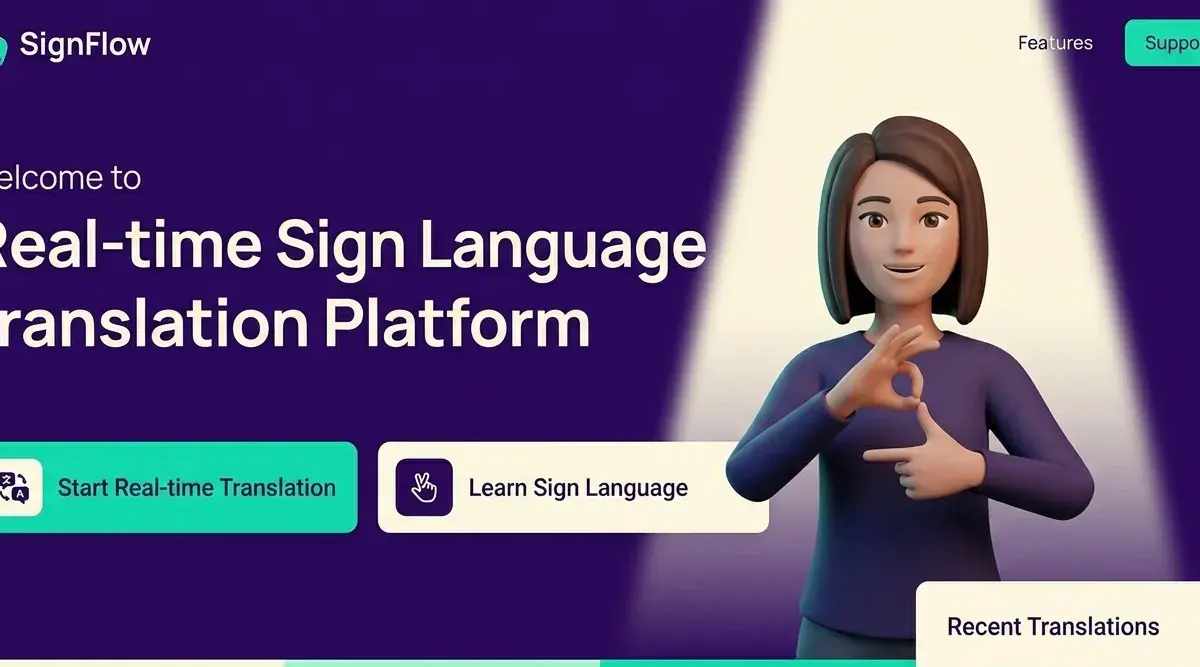
Building SignFlow: Real-Time Assistive Sign Language Translation with Three.js and WebSockets
Building SignFlow: Real-Time Assistive Sign Language Translation with Three.js and WebSockets is a Developer Journal article by Ancel Ajanga on https://ancel.co.ke. Exploring the architecture of an assistive technology platform: translating natural text into 3D avatar sign language animations using Three.js, WebSockets, and phonemic gesture queues. It focuses on: Standard accessibility tools often fail deaf and hard-of-hearing users in fast-paced real-time environments where captions cause cognitive fatigue or lac…
Exploring the architecture of an assistive technology platform: translating natural text into 3D avatar sign language animations using Three.js, WebSockets, and phonemic gesture queues.
Who this is for
Frontend engineers, 3D graphics developers, and accessibility advocates exploring how real-time WebSockets and WebGL can power assistive experiences.
Problem
Standard accessibility tools often fail deaf and hard-of-hearing users in fast-paced real-time environments where captions cause cognitive fatigue or lack spatial expressiveness.
Business outcome
An interactive 3D simulation streaming real-time text-to-sign translations via skeletal avatar animation, featuring phonemic gesture synchronization and real-time WebSocket delivery.
Metrics
- WebGL skeletal avatar animation with Three.js
- Real-time token-to-gesture dispatch over WebSockets
- Keyboard and screen reader accessibility support
For millions of deaf and hard-of-hearing individuals, accessibility on the modern web remains an uphill battle. While automated closed captions have improved, text alone does not capture the rich spatial, grammatical, and facial nuances of sign language. In fast-paced lectures, presentations, or emergency announcements, reading continuous walls of captions induces severe cognitive fatigue.
Inspired by modern accessibility tools like Signvrse's Terp 360, I built SignFlow as an exploration into **assistive 3D graphics and real-time translation pipelines**. The platform translates natural text into fluid 3D avatar sign animations in real time.
The Problem: Real-Time Spatial Translation
Translating speech or text into sign language is not a simple word-for-word replacement. Sign languages (such as ASL or Kenyan Sign Language) possess their own distinct grammatical structures, spatial reference points, and non-manual markers (facial expressions and head tilts).
Existing software approaches typically rely on pre-recorded video clips stitched together. However, video stitching has severe drawbacks: - Transitions between words appear abrupt and disjointed. - Pre-recorded video requires substantial bandwidth, making it unusable over constrained mobile networks. - Adding new vocabulary requires recording a human actor in a studio with consistent lighting and angles.
Using a real-time 3D avatar driven by procedural skeletal animations solves these challenges by transmitting lightweight animation keyframes instead of heavy video streams.
Technical Architecture: Tokenization, WebSockets, and WebGL
SignFlow is organized into three pipeline stages:
### 1. Linguistic Parsing & Tokenization (Node.js) Incoming text streams are parsed into grammatical tokens. The engine maps English idioms into sign-gloss sequences, separating finger-spelled terms from established lexical signs.
### 2. Real-Time Streaming (WebSockets) Instead of streaming 3D mesh geometry, the server streams lightweight **Phonemic Gesture Instructions**: - Sign identifier. - Skeletal bone transform matrices (hand shape, palm orientation, arm trajectory). - Blend-shape weights for facial expressions (eyebrow raises, mouth morphemes). - Timing and interpolation curves. This reduces network bandwidth to under 2KB per translated phrase, enabling fluid streaming even over 3G cellular connections.
### 3. Avatar Rendering Engine (Three.js & WebGL) The client frontend renders a rigged 3D human avatar using **Three.js**: - **Skeletal Inverse Kinematics (IK)**: Ensures hands reach target chest, face, and neutral spatial zones smoothly without clipping through the body mesh. - **Spherical Linear Interpolation (SLERP)**: Transitions between consecutive signs with smooth quaternion rotation blending, eliminating robotic, jerky movements. - **Morph Targets for Facial Expressiveness**: Controls subtle eyebrow and mouth shape expressions synchronized with hand gestures.
ypescript
// Smooth gesture interpolation loop
function animateTransition(
  avatar: THREE.SkinnedMesh,
  fromPose: PoseKeyframe,
  toPose: PoseKeyframe,
  alpha: number
) {
  avatar.skeleton.bones.forEach((bone, index) => {
    const startRot = fromPose.rotations[index];
    const endRot = toPose.rotations[index];
    if (startRot && endRot) {
      bone.quaternion.slerpQuaternions(startRot, endRot, alpha);
    }
  });
}
Accessibility-First Design Principles
An assistive tool must itself be universally accessible: - **WCAG 2.1 AA Compliance**: High contrast ratios, clear font scaling, and zero flashing content. - **Full Keyboard Navigation**: Users can control avatar playback speed, camera angles, lighting presets, and sign replay entirely via keyboard shortcuts. - **Screen Reader Announcements**: Live translation status, active sign descriptions, and dictionary definitions are synchronized with ARIA live regions (`aria-live="polite"`).
Key Engineering Takeaways
1. **Lightweight Animation Data Beats Video Streaming**: Transmitting skeletal transform quaternions over WebSockets requires orders of magnitude less bandwidth than video, democratizing access for low-bandwidth regions. 2. **Smooth Transitions Require Quaternion Slerp**: Human signing relies on continuous movement. Clamping poses together without quaternion spherical linear interpolation creates an uncanny, robotic experience. 3. **Accessibility is an Architectural Choice**: Building accessibility features at the foundation rather than as an afterthought makes complex 3D applications intuitive for everyone.
Review the SignFlow Project Details or inspect my other [software engineering projects](/projects).
Trade-offs
Selected skeletal morph targets in Three.js over pre-rendered video clips to enable fluid dynamic vocabulary composition and minimal client bandwidth consumption.
Challenges faced
Synchronizing complex hand and facial skeletal blend shapes in real-time while keeping animation smooth on resource-constrained client devices.